- Snowflake - Home
- Snowflake - Introduction
- Snowflake - Data Architecture
- Snowflake - Functional Architecture
- Snowflake - How to Access
- Snowflake - Editions
- Snowflake - Pricing Model
- Snowflake - Objects
- Snowflake - Table and View Types
- Snowflake - Login
- Snowflake - Warehouse
- Snowflake - Database
- Snowflake - Schema
- Snowflake - Table & Columns
- Snowflake - Load Data From Files
- Snowflake - Sample Useful Queries
- Snowflake - Monitor Usage and Storage
- Snowflake - Cache
- Unload Data from Snowflake to Local
- External Data Loading (from AWS S3)
- External Data Unloading (Into AWS S3)
- Snowflake Resources
- Snowflake - Quick Guide
- Snowflake - Useful Resources
- Snowflake - Discussion
Snowflake - Functional Architecture
Snowflake supports structured and semi-structured data. Snowflake organizes and structures the data automatically once data loading is completed. While storing the data, Snowflake divides it on his intelligence and saves into different micro-partitions. Even Snowflake stores data into different clusters.
At functional level, to access data from Snowflake, the following components are required −
Choose proper roles after logging
Virtual Warehouse known as Warehouse in Snowflake to perform any activity
Database Schema
Database
Tables and columns
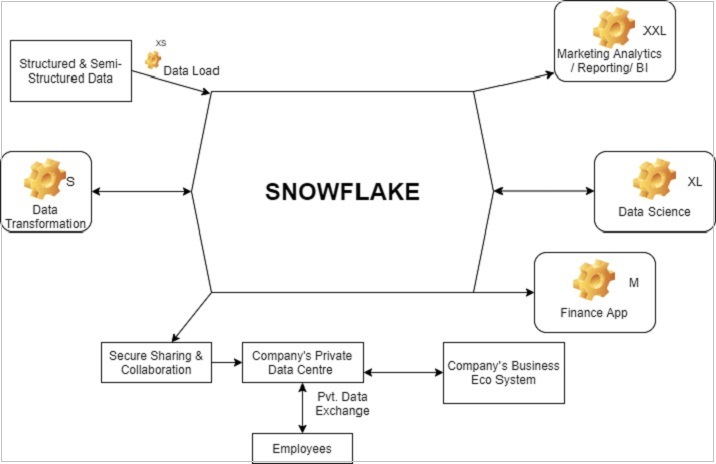
Snowflake provides the following high-level analytics functionalities −
Data Transformation
Supports for Business Application
Business Analytics/Reporting/BI
Data Science
Data Sharing to other data systems
Data Cloning
The following diagram shows the functional architecture of Snowflake −
The symbol of "settings" as in each block can be referred as Warehouse and XS, XXL, XL, L, S as sizes of warehouse requires to perform different operations. Based on requirement and usage, the size of a warehouse can be increased or decreased; even it can be converted from single cluster to multi-clusters.