
 Data Structure
 Networking
 RDBMS
RDBMS Operating System
 Java
Java MS Excel
 iOS
iOS HTML
HTML CSS
CSS Android
 Python
 C Programming
 C++
C++ C#
C# MongoDB
 MySQL
MySQL Javascript
 PHP
PHPJump if carry (JC) in 8085 Microprocessor
In 8085 Instruction set, we are having one mnemonic JC a16, which stands for “Jump if Carry” and “a16” stands for any 16-bit address. This instruction is used to jump to the address a16 as provided in the instruction. But as it is a conditional jump so it will happen if and only if the present carry flag value is 1.If carry flag value is 0, program flow continues sequentially. It is a 3-Byte instruction.
| Mnemonics, Operand |
Opcode(in HEX) |
Bytes |
|---|---|---|
| JC Label |
DA |
3 |
Let us consider one example of this instruction type JC 4000H. It is a 3-Byte instruction. The result of execution of this instruction is shown below with an example.
| Address |
Hex Codes |
Mnemonic |
Comment |
|---|---|---|---|
| 2000 |
37 |
STC |
Set Cy flag bit. So Cy = 1 |
| 2001 |
D2 |
JC 4000 |
Jump Carry, i.e. Jump when Cy = 1 |
| 2002 |
00 |
|
Low order Byte of the target address |
| 2003 |
40 |
|
High order Byte of the target address PC ← 4000H, So the program control will be transferred to the address 4000H |
| 2004 |
78 |
MOV A, B |
This instruction will not get control now as JC will transfer the control to the memory address 4000H |
| …. |
…. |
…. |
…. |
| 4000 |
41 |
MOV B, C |
Next instruction at address 4000H will get the control |
The timing diagram against this instruction JC 4000H execution is as follows –
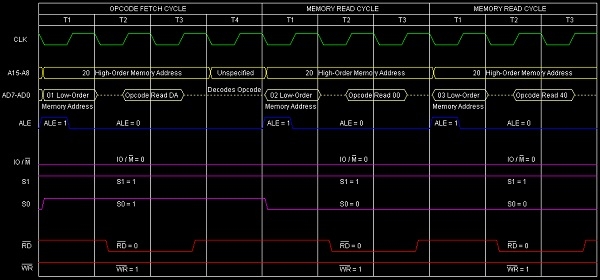
Summary − So this instruction JC requires 3-Bytes, 3-Machine Cycles (Opcode Fetch, Memory Read, MemoryRead) and 10 T-States for execution as shown in the timing diagram.

6K+ Views
