
Article Categories
- All Categories
-
 Data Structure
-
 Networking
-
 RDBMS
RDBMS
-
 Operating System
-
 Java
Java
-
 MS Excel
-
 iOS
iOS
-
 HTML
HTML
-
 CSS
CSS
-
 Android
-
 Python
-
 C Programming
-
 C++
C++
-
 C#
C#
-
 MongoDB
-
 MySQL
MySQL
-
 Javascript
-
 PHP
PHP
-
 Economics & Finance
Selected Reading
Find the unit place digit of sum of N factorials using C++.
Here we will see how to get the unit place digit of the sum of N factorials. So if N is 3, then after getting sum, we will get 1! + 2! + 3! = 9, this will be the result, for N = 4, it will be 1! + 2! + 3! + 4! = 33. so unit place is 3. If we see this clearly, then as the factorials of N > 5, the unit place is 0, so after 5, it will not contribute to change the unit place. For N = 4 and more, it will be 3. We can make a chart for the unit place, and that will be used in the program.
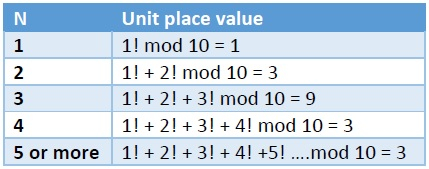
Example
#include<iostream>
#include<cmath>
using namespace std;
double getUnitPlace(int n) {
   int placeVal[5] = {-1, 1, 3, 9, 3};
   if(n > 4){
      n = 4;
   }
   return placeVal[n];
}
int main() {
   for(int i = 1; i<10; i++){
      cout << "Unit place value of sum of factorials when N = "<<i<<" is: " << getUnitPlace(i) << endl;
   }
}
Output
Unit place value of sum of factorials when N = 1 is: 1
Unit place value of sum of factorials when N = 2 is: 3
Unit place value of sum of factorials when N = 3 is: 9
Unit place value of sum of factorials when N = 4 is: 3
Unit place value of sum of factorials when N = 5 is: 3
Unit place value of sum of factorials when N = 6 is: 3
Unit place value of sum of factorials when N = 7 is: 3
Unit place value of sum of factorials when N = 8 is: 3
Unit place value of sum of factorials when N = 9 is: 3

Updated on: 2019-10-30T06:37:53+05:30
259 Views

Advertisements