
Article Categories
- All Categories
-
 Data Structure
-
 Networking
-
 RDBMS
RDBMS
-
 Operating System
-
 Java
Java
-
 MS Excel
-
 iOS
iOS
-
 HTML
HTML
-
 CSS
CSS
-
 Android
-
 Python
-
 C Programming
-
 C++
C++
-
 C#
C#
-
 MongoDB
-
 MySQL
MySQL
-
 Javascript
-
 PHP
PHP
-
 Economics & Finance
C++ Remove Nodes on Root to Leaf Paths of Length < K
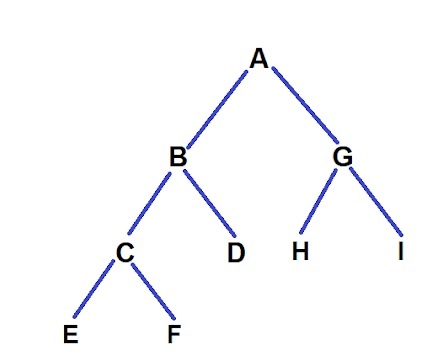
Given a tree, and we need to remove the leaf node of the path having a length less than the given k, for example.
Input −
K = 4.
Output −
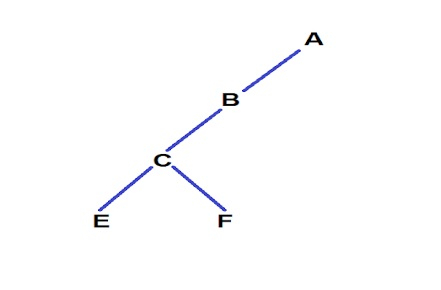
Explanation
The paths were :
1. A -> B -> C -> E length = 4
2. A -> B -> C -> F length = 4
3. A -> B -> D length = 3
4. A -> G -> H length = 3
5. A -> B -> I length = 3
Now as you can see paths 3, 4, 5 have length of 3 which is less than given k so we remove the leaf nodes of these paths i.e. D, H, I.
Now for path 4 and 5 when H and I are removed we notice that now G is also a leaf node with path length 2 so we again remove node G and here our program ends.
We will traverse the tree in the post-order format; then, we create a recursive function that removes our leaf nodes if their path length is less than K.
Approach to Find the Solution
In this approach, we traverse in post-order traversal now; we try to recursively remove the leaf nodes that have path lengths less than k and continue like this.
Example
C++ Code for the Above Approach
#include<bits/stdc++.h>
using namespace std;
struct Node{ // structure of our node
    char data;
    Node *left, *right;
};
Node *newNode(int data){ // inserting new node
    Node *node = new Node;
    node->data = data;
    node->left = node->right = NULL;
    return node;
}
Node *trimmer(Node *root, int len, int k){
    if (!root) // if root == NULL then we return
        return NULL;
    root -> left = trimmer(root -> left, len + 1, k); // traversing the left phase
    root -> right = trimmer(root -> right, len + 1, k); // traversing the right phase
    if (!root -> left && !root -> right && len < k){
        delete root;
        return NULL;
    }
    return root;
}
Node *trim(Node *root, int k){
    return trimmer(root, 1, k);
}
void printInorder(Node *root){
    if (root){
        printInorder(root->left);
        cout << root->data << " ";
        printInorder(root->right);
    }
}
int main(){
    int k = 4;
    Node *root = newNode('A');
    root->left = newNode('B');
    root->right = newNode('G');
    root->left->left = newNode('C');
    root->left->right = newNode('D');
    root->left->left->left = newNode('E');
    root->left->left->right = newNode('F');
    root->right->left = newNode('H');
    root->right->right = newNode('I');
    printInorder(root);
    cout << "\n";
    root = trim(root, k);
    printInorder(root);
    return 0;
}
Output
E C F B D A H G I
E C F B A
Explanation of the Above Code
In this code, we are using a recursive function that is traversing our tree and keeping the stats of the left and right subtrees. Now we arrive at a leaf node; we check the path length till that node. If the path length is less, then we delete this node, and then we return NULL; otherwise, the code continues.
Conclusion
In this tutorial, we solve a problem to Remove nodes on the root to leaf paths of length

252 Views
