
Article Categories
- All Categories
-
 Data Structure
-
 Networking
-
 RDBMS
RDBMS
-
 Operating System
-
 Java
Java
-
 MS Excel
-
 iOS
iOS
-
 HTML
HTML
-
 CSS
CSS
-
 Android
-
 Python
-
 C Programming
-
 C++
C++
-
 C#
C#
-
 MongoDB
-
 MySQL
MySQL
-
 Javascript
-
 PHP
PHP
-
 Economics & Finance
Construct a TM that accepts even-length palindromes over the alphabet {0,1}?
A Turing machine (TM) is a 7-tuple (Q, ∑, Γ, δ, q0, qaccept , qreject).
Where,
Q is a finite set of states.
∑ is the input alphabet that does not contain the blank symbol t.
Γ is the tape alphabet, where t ∈ Γ and ∑ ⊆ Γ.
δ: (Q × Γ) → (Q × Γ × {L, R}) is the transition function.
q0 ∈ Q is the start state.
qaccept ∈ Q is the accept state.
qreject ∈ Q is the reject state, where qreject ≠ qaccept.
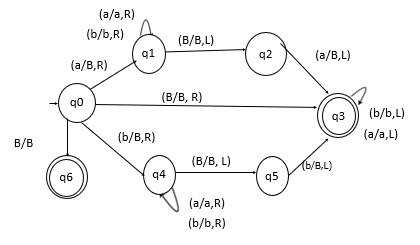
For accepting even-length palindrome over the alphabet {0,1}, follow the steps given below −
Match the first and last element and erase them and go on doing the same. Once we reach epsilon without any mismatch then the string is even-length palindrome.
For an even-length palindrome a TM is defined after the machine runs and erases the first and last element without encountering a mismatch. Later on the turing machine accepts the string and the string is even-length palindrome.
Let the string be −
110011
Then, we can encounter three cases, which are as follows −
Case 1 − If starting and ending matches and then erase the first and last one
After erase − 1001
Case 2 − If starting and ending matches and then erase the first and last one
After erase− 00
Case 3 − If starting and ending matches and then erase the first and last zero
After erase remains − epsilon
This is a Turing machine constructed which accepts an even-length palindrome.
The schematic diagram for TM accepting the even-palindrome is as follows −

12K+ Views
