
Article Categories
- All Categories
-
 Data Structure
-
 Networking
-
 RDBMS
RDBMS
-
 Operating System
-
 Java
Java
-
 MS Excel
-
 iOS
iOS
-
 HTML
HTML
-
 CSS
CSS
-
 Android
-
 Python
-
 C Programming
-
 C++
C++
-
 C#
C#
-
 MongoDB
-
 MySQL
MySQL
-
 Javascript
-
 PHP
PHP
Selected Reading
Linear Regression
From a given set of data points, the linear regression finds an equation of straight line. The given points will follow the straight line. Using this formula, we can predict what will be the value for some other specific point, which is not present in the set currently.
For solving linear regression problems using some data points, we have to follow these formulae:
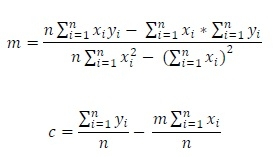
Here the m and c are the slope and the y-intercept respectively. Using these expressions, we can get the equation of straight line in this form: ? = ?? + ?.
Input and Output
Input:
The (x, y) coordinates of some points. {(1,3), (2,4), (3,5), (4,6), (5,8)}
Output:
The slope: 1.2 The Intercept: 1.6
The equation: y = 1.2x + 1.6
Algorithm
linReg(coord)
Input: The given set of coordinate points.
Output: The slope m and y-intercept c.
Begin
   for i := 1 to n, do
      sumX := sumX + coord[i,0]
      sumY := sumY + coord[i,1]
      sumXsq := sumXsq + (coord[i,0]*coord[i,0])
      sumXY := sumXY + (coord[i,0] * coord[i,1])
   done

   m := (n * sumXY – (sumX*sumY)) / (n * sumXsq – (sumX * sumX))
   c := (sumY / n) – (m * sumX)/n
End
Example
#include#include #define N 5 using namespace std; void linReg(int coord[N][2], float &m, float &c) { float sx2 = 0, sx = 0, sxy = 0, sy = 0; for(int i = 0; i Output
The slope: 1.2 The Intercept: 1.6 The equation: y = 1.2x + 1.6

Updated on: 2020-06-17T08:47:12+05:30
1K+ Views

Advertisements